Maren
Bones & AllMaren’s childhood is defined by a terrible contradiction: she is a child loved and cared for, yet her hunger turns that intimacy into violence. The first account of her cannibalistic nature also establishes the distance between what she remembers and what she knows about herself, a gap that shadows her understanding of family and identity.
Identity and Early Life
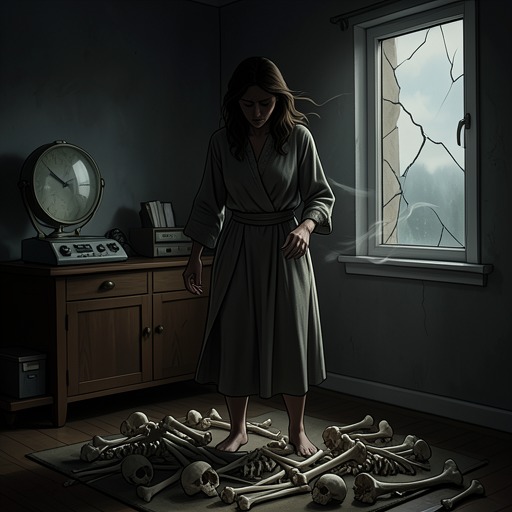
When Maren was a baby, Penny Wilson was supposed to watch her for only an hour and a half. Maren later imagines that Penny wanted a baby of her own and loved her too much, picturing her humming a lullaby, touching each tiny finger and toe, kissing her cheeks, and blowing on the down of her head. This imagined tenderness makes the discovery that follows more disturbing: Maren had teeth, but was too small to swallow the bones, which her mother found piled on the living-room carpet.
Maren does not remember the killing herself. She knows it through what her mother later told her and through the details she assembles retrospectively: her mother screamed when she found Penny, and initially suspected a satanic cult. Maren rejects that explanation. She was found asleep beside the bones, with tears drying on her cheeks and blood around her mouth. The distinction between memory and knowledge matters: the scene is unavailable to her as lived recollection, but it becomes part of the story through which she understands herself. Even as a baby, she says, she loathed herself.
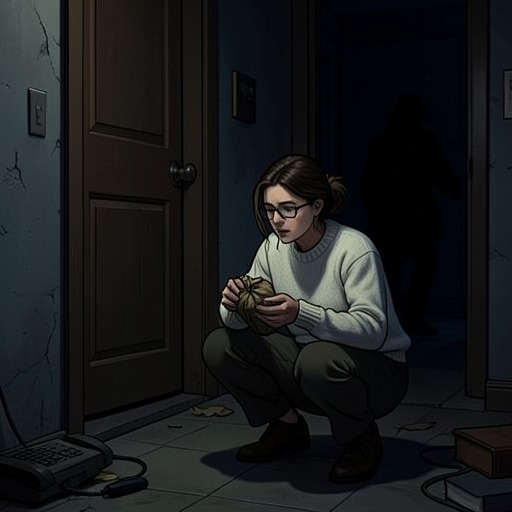
Her mother’s departure makes that early separation from ordinary family life newly immediate. Maren wakes to an unusually still apartment and the absence of the smell of coffee, then finds a note on the kitchen table: “I’m your mother and I love you but I can’t do this anymore.” She looks at her hands as if they do not belong to her, and feels the same estrangement from the chair, table, window, and mother around her. The note affirms love while announcing its limit; Maren is left to experience abandonment not as an abstract fact but as the sudden collapse of the familiar world.
The next morning, Maren throws a dish onto the floor simply to discover what it feels like to do so. She steps over the fragments and opens a thick white envelope her mother left behind, finding money and Maren’s birth certificate. Blue and crinkly, the document becomes more than proof of birth: Maren calls it sacred even for a monster like her. Its ordinary authority stands against her self-image, preserving a place for her in the human world at the same moment she describes herself as outside it.
The Search for Her Father
Maren’s birth certificate gives her a document of origin, but not an account of the father she has never known. She recalls asking her mother about him once and hearing that he was gone; her follow-up question was what his name had been. The answer does not appear in the available account, leaving the identity behind the certificate unresolved.
Later, speaking with Sullivan, Maren names Minnesota as her destination. It is where her father is from, she says, adding only that perhaps he is still there. The qualification matters: this is not a confident reunion plan but a possibility she follows without knowing whether it can lead to him. Her journey begins with a place and a hope rather than a relationship already secured.
Another recorded stretch of the road brings Maren into a car with Lee. An envelope from the dashboard bears Barry Cook’s name and a Pittston, Iowa, address, and after they take the exit for Route 13, Lee asks Maren’s name. She gives it, and he gives his in return. The brief exchange marks their first introduction in the car, amid a journey whose destination is identified by the address on the envelope.
Work, Reading, and Intimacy
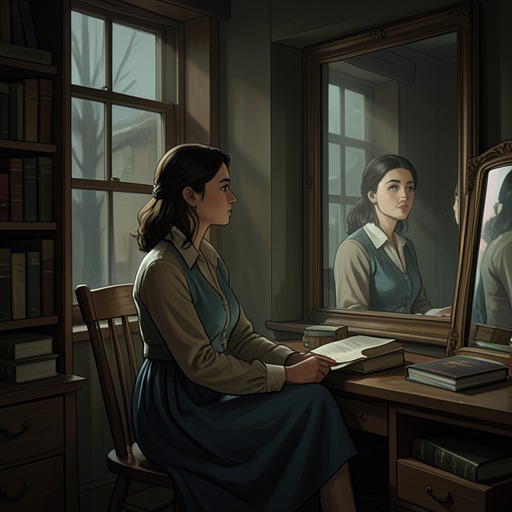
Maren eventually builds a modest routine around her library work. She shelves books, spends lunch with a tuna sandwich and an Anne Rice novel in a secluded corner, then returns to the spare room in Mrs. Clipper’s house to finish whatever she has begun reading. On two mornings off each week, she sits in on lectures and takes notes as if her grade depended on them. The pattern gives her a practical structure, but it is vulnerable to interruption: when Jason is at the library, especially when he follows her into the stacks, she loses sight of routine.
A brief encounter with Wayne shows Maren testing a different kind of connection. He introduces himself as a Ph.D. student; she gives her name, recognizes the distinction between wryness and sarcasm in his manner, and decides she likes him. Wayne makes clear that he respects her, a response Maren values even while she expects they will never be friends. The exchange is small, but it sets respect apart from intimacy: she can appreciate being taken seriously without mistaking that regard for a lasting bond.
With Jason, the library’s stacks become a more charged space. He startles her among the shelves, then asks her to put down the books she is carrying. When he says her name, Maren tries not to shiver; she follows the pull she feels toward him as he asks permission to touch her locket. He opens it to reveal a photograph of Douglas Harmon, whose movie-star smile belongs to a long-dead photographer’s image. The locket thus brings a private attachment into their encounter before either of them speaks plainly about what is happening between them.
Later, Maren leads Jason through a coded door into the closed stacks, winding between shelves of rare books under lights that flicker and fail. She begins unbuttoning Kerri-Ann’s frilly black blouse and removes it; when she turns back, Jason is undoing his belt. Maren’s skin rises in gooseflesh as she gathers up her shirt and tucks it above a row of books. Jason asks whether they are safe and whether anyone will find them. Maren answers that she cannot be sure of anything, then recognizes the force of her own words only after saying them. In the library, her ordered workday and carefully secluded reading give way to an encounter whose physical secrecy echoes a deeper uncertainty.
Narrative Perspective and Self-Knowledge
Maren’s account makes the limits of memory part of her characterization. The scene of Penny Wilson’s death is not presented as a recovered infant memory: Maren distinguishes what she cannot remember from what she has learned, including her mother’s scream and the blood around her own mouth. Her imagined picture of Penny’s tenderness is explicitly conjectural, while the bones and Maren’s position beside them anchor the account in reported facts. By holding speculation and knowledge together, the retrospective narration shows how Maren builds an understanding of herself from other people’s testimony and the evidence they leave behind. The result is not certainty about what she experienced as a baby, but certainty that the event has become inseparable from the person she believes herself to be.